

- Home
- Community
- News Blog
- Resources
- Journals
- Events and Training
- About Us
- Contact Us

Churches
Display in alphabetical order | Display most recent first | Display most viewed first
A tool which churches perceive to be of value in furthering their goals
Author: Keith Benn
What excites us most is that people who have never before led a Bible study are now having regular studies in their homes.
This article relates how Bible study cassettes on Genesis 1-11 and James have had a big impact on the Central Bontoc people of the Philippines. It outlines the format of the Bible studies and the ways they have been used both within churches and in evangelism, and how they support the development of literacy. [more...]
Como tornar a Bíblia relevante para todas as línguas e culturas
Authors: Harriet Hill, Margaret Hill
Published by: Vida Nova (2010)
This is the Brazilian Portuguese version of the book Translating the Bible into Action by Harriet Hill and Margaret Hill.
A tried and tested resource that encourages meaningful Bible use in multi-lingual contexts through both written and oral media. Includes activities, assignments, further reading resources and links to useful websites.
This version has two extra chapters in addition to those found in the English version - "Addressing human concerns: Alcohol abuse", and "Sharing your faith with animists". [more...]
Audio downloads, Proclaimer, BibleStick, MP3 CDs
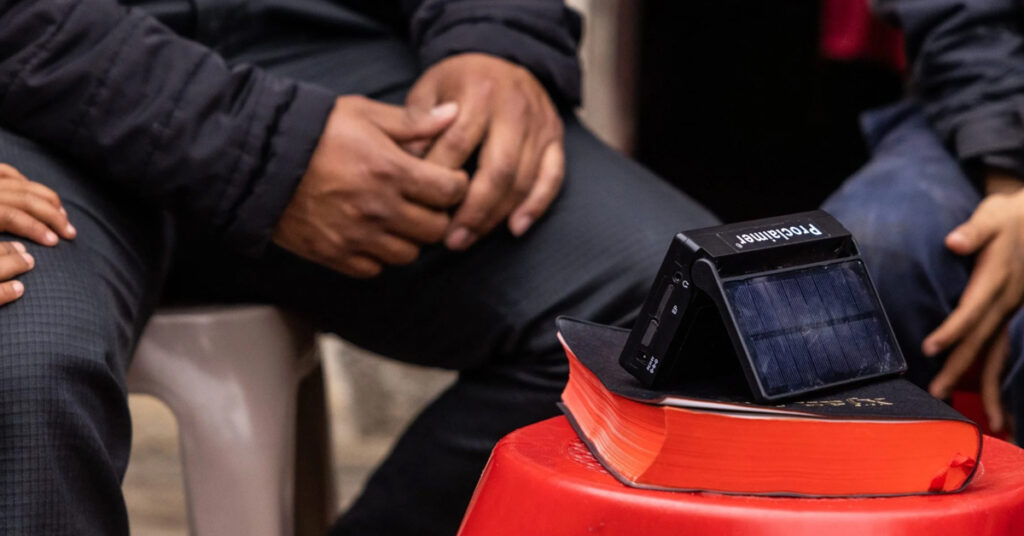
Faith Comes By Hearing is committed to reaching the nations with the Word of God in audio. Their strategy includes setting up listening groups which meet weekly to listen to the Scriptures in the local language. In 40 weeks such groups can hear the whole New Testament from start to finish. This is done with the help of the solar-powered Proclaimer audio player. [more...]
A Student's Manual for Scripture Use
Author: Edna Headland
Pastors who have studied in a language other than their mother tongue can have difficulty using the local language Scriptures. When they preach, they sometimes borrow words from the language in which they studied, rather than thinking about the word that will communicate best in their local language.
For this reason Bible Institutes, seminaries and churches should encourage those who study the Bible to use the translation in their own language and investigate how important terms were translated.
On completing this 43 lesson course, a speaker with the Scriptures in their own language will be able to:
- identify how key terms in their language are translated;
- use the terms when they teach or preach;
- better understand the doctrine based on or related to the key term;
- attach greater value to the Scriptures in their language since they know that there are appropriate ways to communicate key terms in their own language and that it may change according to the context;
- use the Scriptures with more confidence and motivate other people in their ethnic group to do so.
The course is also available in Spanish and Portuguese. [more...]
A church-based literacy program for Ghana
Author: Pat Herbert
The pastor will find that not only can his congregation read the Scriptures in their own language, but they will show a greater depth of understanding God’s Word and show growth in their Christian lives.
Community literacy projects have been running in Ghana since the 1970s. Pastors, however, were not using the mother-tongue Scriptures in their churches. To address this problem, Pat Herbert describes how they developed Scripture Guides to accompany literacy primers. The program is now known as Literacy for Life (LFL). The article includes a sample of a Scripture Guide lesson, and discusses various issues, including training of teachers to use the materials, making it a church-based program, and funding for the primers and Scripture Guides. It compares the normal literacy programs to the LFL program and describes the impact the program has had. [more...]
Author: John Ommani
"Pastors have taken on the 'lecture' method to display the 'big man' syndrome which does not allow the people to engage. They are expected to sit and listen and remain silent. They feel this is how the church has to operate. The pastor simply tells them what the Bible says and what they need to do. They are not able to live out what they are told because they still have unanswered questions."
The model of the pastor as 'big man' who knows it all means that people have to sit and listen, and often this does not lead to engagement with Scripture in life-transforming ways. In many traditional cultures, leaders taught through stories, questions, and riddles, allowing people to interact and discover. Can pastors today learn to use discovery methods in the church that allow people to interact with Scripture and discover lessons for themselves? This article says yes, with field experience from Africa to demonstrate it. [more...]
An initiative aiming to improve biblical literacy in the church
"Read the Bible for Life aims to improve biblical literacy in the culture and the church by simultaneously moving readers toward greater skill in reading the Bible well and toward a deeper commitment to applying Scripture to everyday life."
The Read the Bible for Life initiative seeks to accomplish two things foundationally:
"1. We want to help people learn to read the parts of Scripture well, so they know how to engage a psalm, or an Old Testament story, or a parable, applying the word in specific, life-changing ways. 2. We want to help people understand how the grand story of the Bible fits together, so they can understand their place in that grand story that God has written on the world."
On the initiative's website you'll find videos, podcasts, blog posts, as well as details of the book "Read the Bible for Life" by George Guthrie (Union University). [more...]
A new way of getting people to get to grips with Scripture
Author: Steve Levy
Published by: Evangelicals Now (March 2010)
"There used to be just three people in our church reading through the Bible — now there are 150. One older lady, a believer since her 20s, had attempted to read the Bible through for years and every time had given up. ‘Now, together with everyone else, I think I’m going to do it’, she said."
Steve Levy describes how his church has divided everybody up into small groups - Read the Bible Together groups - which meet together once a month. Before coming to the group, people are asked to read or listen to a book of the Bible. They then come together to share what God has been teaching them: "We need to help each other. The Bible is written to be talked about. It grows. It is not bound." [more...]
What future is there for the Bible in our churches?
Author: Henri Bacher
"The greatest difficulty is no longer distribution, but appropriating the content of the Bible... There is a need to teach believers to meditate and, as in any learning process, you have to give regular booster injections if you want people to continue. We have often rambled on about the Bible, in sermons and Bible studies, but have we truly helped Christians to engage with the Bible in their day-to-day living?"
In this article, Henri Bacher describes some of the reasons for the erosion of Bible practice in the church and in believers' lives. Rather than starting with communication techniques, his suggested solutions major on the value of community. The idea is to encourage group interaction, networking and mutual encouragement, helping others to enter into regular, personal meditation. [more...]
Reading big chunks of Scripture, out loud, together
Author: Carl Laferton
Published by: The Briefing, 3 November 2011
"What we are trying to do is say we want our people to know the Scripture — and how will they know the Scriptures other than by reading it? And what’s the best way to read it? I’m convinced that it’s designed to be read in big chunks, out loud, with people getting together."
Cornerstone Church in Kingston, UK, have embarked on 'The Big Read'. The idea is to read one book of the Bible each month, together in small groups.
On the first Sunday of the month, the pastor preaches an overview of the book. Then at the midweek prayer meeting, they read the first few chapters together, leaving the rest for the small groups during the other weeks of the month. They've put together a series of 10 questions to help them reflect on what they're reading.
For more details, see the article in The Briefing, which contains some provocative thoughts on Bible reading from Cornerstone's pastor, Pete Woodcock. [more...]