


Engaging Different Audiences
Sunday School lesson plans based on the "Good News" and "Look, Listen and Live" series of audio-visual materials from Global Recordings.
From the description:
"Each lesson plan has a clear aim which is outlined at the beginning of each lesson and sustained throughout the lesson. Each lesson's scripture reading provides a sound biblical foundation for the teaching material. A memory verse encourages children to commit scripture to memory. [more...]
When the Bible remains silent about certain cultural features, the Church... should assist the Christians to think through their traditions by digging deeper.
In the Tharaka society of Kenya, female circumcision has held a prominent place. In recent years Christian Tharaka people have questioned whether the rite should continue. The Bible Translation and Literacy agency has had a part in helping the society look at this rite from a biblical perspective. This article chronicles the history of the rite, including both its positive elements and problems, and some alternatives are presented. [more...]
So I offer the challenge: that we inhabit this digital space, become part of the culture and learn the language of what Marc Prensky calls the, 'Digital Natives'. Those of us who have adopted technology later in life he describes as, 'Digital Immigrants' and like anyone immigrating to a new country, there is a need to learn.
Mark Brown, CEO of Bible Society New Zealand, outlines some of the cultural shifts that need to be understood in order to encourage Scripture engagement among 'digital natives'.
At Bible Society New Zealand in response to the appalling Bible engagement rates amongst Christians we wanted to find out, 'Why don’t people read there Bible more often?' The overwhelming reason is that people are distracted, their attention drawn to other things as they scan their environment.
To stimulate conversation, the author presents some provocative predictions of how the web might influence the production, understanding and appreciation of the Bible.
The paper was presented at the symposium: Christianity in the Digital Space, at St. John's College, Durham, UK, July 2009. Notes on the subsequent discussion can be found here. [more...]
"The greatest difficulty is no longer distribution, but appropriating the content of the Bible... There is a need to teach believers to meditate and, as in any learning process, you have to give regular booster injections if you want people to continue. We have often rambled on about the Bible, in sermons and Bible studies, but have we truly helped Christians to engage with the Bible in their day-to-day living?"
In this article, Henri Bacher describes some of the reasons for the erosion of Bible practice in the church and in believers' lives. Rather than starting with communication techniques, his suggested solutions major on the value of community. The idea is to encourage group interaction, networking and mutual encouragement, helping others to enter into regular, personal meditation. [more...]
"The Bible has yet to beat the perception of being a dusty old rule book among millennials largely because to substantiate relevance and garner interest, the text first must be read... The message of the Bible is unchanging, but how we deliver that message not only can change, but must."
Lamar Vest discusses some of the strategies the American Bible Society is using to encourage the millennial generation to engage with the Scriptures, including creative delivery methods and "new tools that put the user in the driver's seat of their Bible experience". [more...]
"What we are trying to do is say we want our people to know the Scripture — and how will they know the Scriptures other than by reading it? And what’s the best way to read it? I’m convinced that it’s designed to be read in big chunks, out loud, with people getting together."
Cornerstone Church in Kingston, UK, have embarked on 'The Big Read'. The idea is to read one book of the Bible each month, together in small groups.
On the first Sunday of the month, the pastor preaches an overview of the book. Then at the midweek prayer meeting, they read the first few chapters together, leaving the rest for the small groups during the other weeks of the month. They've put together a series of 10 questions to help them reflect on what they're reading.
For more details, see the article in The Briefing, which contains some provocative thoughts on Bible reading from Cornerstone's pastor, Pete Woodcock. [more...]
"I realised that no translation was worth anything if my children didn't read it on their own because they wanted to. The burning question for me as a parent was how do I get my children into the word of God so that the word of God would get into them? As a professional illustrator the answer became obvious."
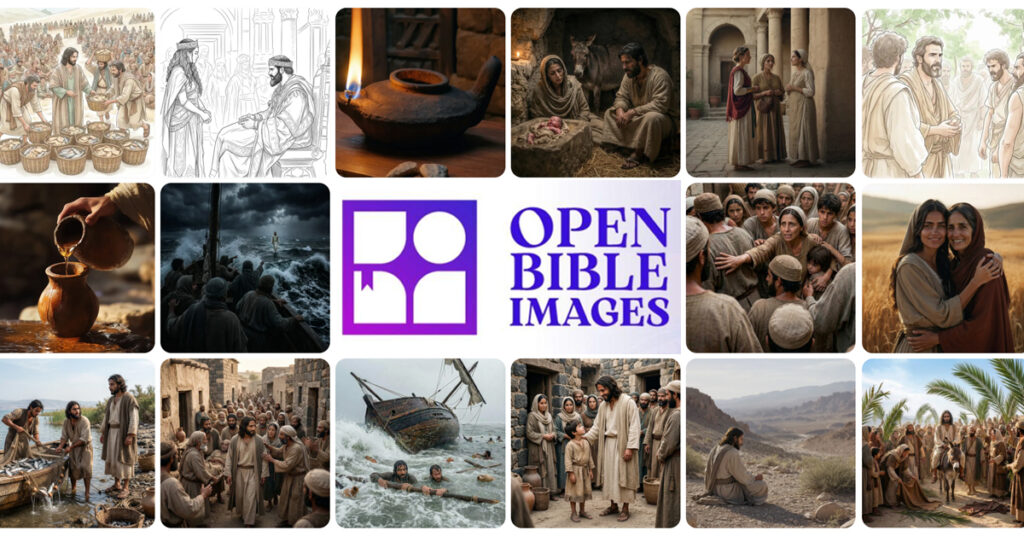
The Illustrated Bible - containing the historical books of the Old and New Testaments - is available in two formats: as illustrated pages and as video. Each Bible story selection contains the full Bible text with accompanying images.
The videos are made from the still images, with the camera moving over the illustrations, zooming in and out, and panning across. The images are realistic rather than using a cartoon style.
There are several free Bible stories and video clips to view online or download, as well as others to purchase. Translation and dubbing is possible into other languages. [more...]
"...the creative engagement between respondents and text results from respondents discovering that the psalms resonate with their idealism and basic human needs in ways that facilitate their ongoing spiritual quest for meaning and enlightenment, as well as providing an opportunity to confront God with complaints and dilemmas."
This study is the account of an empirical research programme in practical theology exploring the potential of the Book of Psalms to facilitate the spiritual journey of a sample of University of Edinburgh students aged between twenty and thirty who are on or beyond the fringes of the churches. Drawing upon some insights of the Bible Society movement regarding ‘scripture engagement,’ and in the wider context of increasing interest in spirituality and decreasing confidence in the churches among many westernised young adults, the project seeks to answer two research questions. [more...]
What is 'The Story'? It is both a book and a campaign.
The book is an abridged version of the NIV Bible, arranging the Biblical narrative in chronological order in 31 chapters. Bridging paragraphs with some explanation are included between the selections of Bible text. There are no verse numbers. A few psalms appear in the chapter on David's life, and Proverbs in the chapter on Solomon. Extracts from Paul's letters appear in the chapter of stories from the book of Acts.
As well as the main version of the book designed for adults, there are also versions for teens and for different ages of children (2-5s, 4-8s, 9-12s).
The campaign is a call for churches to take up 'The Story' as a journey through the Bible for all ages - to encourage people to grasp the Bible narrative and how the different parts of the Bible fit together. There are teaching notes for pastors and group leaders as well as video clips. This could be a 31-week series to go through the whole Story, or churches could adapt parts of it according to their needs.
One of the challenges of producing an abridged Bible is to know which passages to include and which to leave out. Not everyone will agree on the choices made. For example, The Story misses out the Tower of Babel. It would be interesting to compare different panoramic/abridged Bible products as to the decisions they have made. [more...]
"The Story of Jesus for Children" provides a solution to the challenge of teaching children the truth about God and His Son Jesus. This video uses 40 minutes of the original "JESUS" film* and integrates into the drama 22 minutes of new footage with children who might have lived in A.D.30. The video allows children to hear and see the whole story at once, answering questions in clear and concrete terms, and providing fast action. It ends with an invitation, by a child to children, to accept Christ into their lives.