

New Media
Mobile Advance's mission and vision is connecting the unreached with the good news and church of Jesus Christ through the device that connects them with the world- the mobile phone.
At their website you will find:
- Resources to help you to get started and advance in mobile phone empowered ministry;
- Research, reviews, case studies and strategy papers that will help you and the Church to advance into new, more powerful realms of mobile phone outreach;
- A community of like-minded “world Christians” who are using the mobile phone to help bring the gospel to their neighbors and friends. Some of these people have faced the same issues you are facing and have answers you need. Others may be facing barriers you can help them overcome.
The Mobile Ministry Forum (MMF) is a coalition of ministries working towards the goal of giving every unreached person a chance to encounter Christ and His kingdom in a compelling, contextualized fashion through their personal mobile device by 2020.
On the MMF website you can find reports and presentations from the Mobile Ministry Forums of recent years, as well as a blog and mobile best practices. [more...]
A brief introduction to mobile ministry and its place in world missions Author: Keith Williams Published by: Mobile Ministry Forum An exciting growth area for Scripture Engagement practitioners is working out how mobile phones can be used around the world to encourage the use of the Scriptures. This 5-minute video presents an introduction to the possibilities of mobile ministry: [more...] Links: View video on Vimeo | Mobile Ministry Forum |
"Bible students, pastors, missionaries and professors are finding this convenient and easy way to read and study the Bible wherever they live, work or travel."
Olive Tree Bible Software provides solutions for people wanting to use their Bible on their Android, Mac, PC, iPhone, iPod and iPad.
Bibles and other Biblical reference materials are available in an increasing number of languages.
"There is clear confusion among Christians about why they should read the Bible. For many, who have lived a Christian life without much engagement with the Bible, there is no perceived need to engage with it."
This paper, fruit of the recent WWSE Think Tank, seeks to engage with the 'Bible Engagement Crisis' in contexts where Bible availability is high but Bible use is relatively low. The focus is on the emerging generation who are less likely to use the Bible than the generations before them, especially using traditional methods.
After presenting the challenge, Stephen Opie outlines some of the strategic themes emerging, such as:
- establishing relevance by listening first;
- embracing technology, especially the Internet;
- identifying grassroots movements and helping them to grow.
The choice of medium can make a difference, and better artistic quality enhances any communication. However, the most important quality is how relevant the message seems to be to the lives of its hearers. If a hearer (or reader or viewer) thinks the message can make an important difference in his life, he will make an effort to listen, even if the quality is poor. Conversely, if he thinks it says nothing personally relevant, he will ignore even the best presented message. This principle of personal relevance is critical to communication.
Wayne Dye expands upon his third condition for Scripture Engagement:
Accessible forms: People are able to read the Scriptures or hear them from others or by listening to electronic media.
The article describes different ways of making the Scriptures more accessible: storying, literacy, local performing and visual arts, audio recordings, cell phones and video. [more...]
"The Bible" page on Facebook has over 8 million fans. The idea is simple: Scripture verses are posted every day and Facebook users have the opportunity to leave their comments - as they engage with God's Word and with each other. It is not unusual for posted verses to receive several hundred comments and to be 'liked' by several thousand users.
The Bible page was launched by Mark Brown, former CEO of the Bible Society New Zealand, as an experiment in presenting the Scriptures in the Digital Space. The page is now managed by the United Bible Societies. [more...]
So I offer the challenge: that we inhabit this digital space, become part of the culture and learn the language of what Marc Prensky calls the, 'Digital Natives'. Those of us who have adopted technology later in life he describes as, 'Digital Immigrants' and like anyone immigrating to a new country, there is a need to learn.
Mark Brown, CEO of Bible Society New Zealand, outlines some of the cultural shifts that need to be understood in order to encourage Scripture engagement among 'digital natives'.
At Bible Society New Zealand in response to the appalling Bible engagement rates amongst Christians we wanted to find out, 'Why don’t people read there Bible more often?' The overwhelming reason is that people are distracted, their attention drawn to other things as they scan their environment.
To stimulate conversation, the author presents some provocative predictions of how the web might influence the production, understanding and appreciation of the Bible.
The paper was presented at the symposium: Christianity in the Digital Space, at St. John's College, Durham, UK, July 2009. Notes on the subsequent discussion can be found here. [more...]
"The Bible has yet to beat the perception of being a dusty old rule book among millennials largely because to substantiate relevance and garner interest, the text first must be read... The message of the Bible is unchanging, but how we deliver that message not only can change, but must."
Lamar Vest discusses some of the strategies the American Bible Society is using to encourage the millennial generation to engage with the Scriptures, including creative delivery methods and "new tools that put the user in the driver's seat of their Bible experience". [more...]
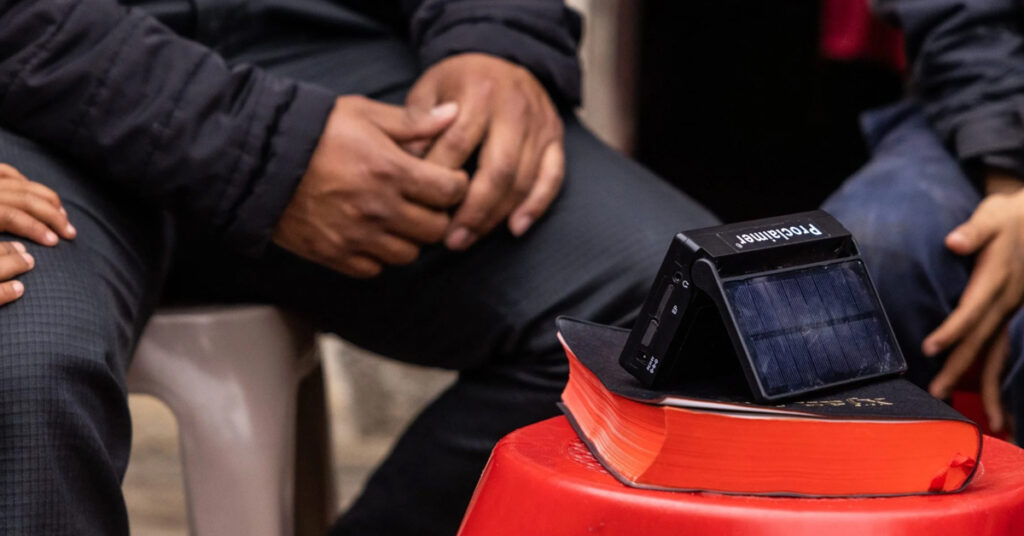
"What we had failed to notice was that these nomads already had media players—their mobile phones! They were using them to listen to music and poetry as well as view videos. This realization changed our strategy, so we now start out by sharing individual Scripture stories on our phone during a visit, and then transfer it by Bluetooth to those who are interested."
This inspiring article encourages us to take advantage of the revolution in mobile phone technology to bring the message of Scripture to peoples around the world. The authors provide lots of examples of how mobile phones can be used.
For example: "When I walk out the door these days I’m blessed to have short selections of the audio panoramic Bible in the language of my people, as well as 40+ videos of Bible stories from creation to the crucifixion. In addition, I have numerous spiritual poems and musical Psalms ready and waiting in my pocket should the right opportunity arise. The great thing is that viewing and sharing photos, music, and videos on mobile phone is now so common among the people group I live among that whipping out my phone and sharing one of these video or audio files with them is completely natural!" [more...]